Bereavement
Mrs. FletcherBereavement in George Rafferty’s life is not a single episode but a succession of family losses and pressures that accumulate around his wife Lorraine’s four-year illness, his mother’s death, and worsening problems involving his father. The strain reaches into his work, his relationships with his children, and his ability to manage his emotions. When he tells Eve Fletcher about this period, grief appears not as a neatly resolved passage but as the background to choices he regrets and a tentative effort to imagine life ahead.
Identity and Background
George had not initially intended to become a plumber. He studied Communications at BU, but partying took precedence over studying, and he left after three semesters. At nineteen, living at home, he drifted into the family plumbing business as his father’s apprentice. What began less as a deliberate choice than as an acceptance of circumstance became a workable life: he liked working with his father, earned good money, bought a house, and built a family. Over time, he became the boss. That settled account of his life, as he presents it to Eve, held together until Lorraine became ill.
The contrast matters to the way he recounts his grief. George does not describe a life that had always been in crisis; he remembers work and family as things that had made sense. Lorraine’s illness disrupted that continuity, and subsequent losses arrived while he was already trying to keep the business running and care for others. His grief is therefore bound up with the collapse of an arrangement in which he had understood himself as a husband, father, son, and working proprietor.
Losses and Caregiving
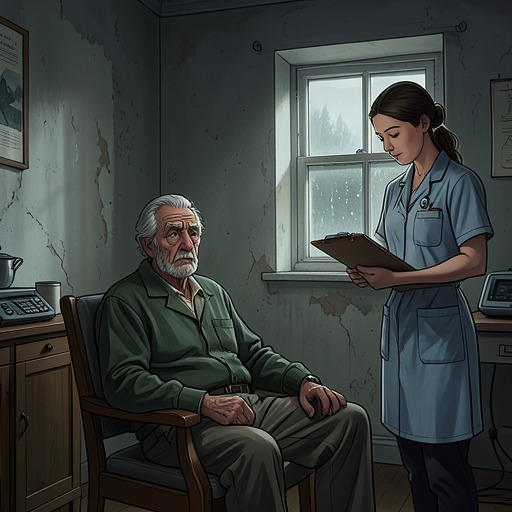
Lorraine’s illness lasted four years. The ordeal included diagnosis, surgery, chemotherapy, and radiation, followed by a brief period of hope, a bad scan, and another turn through the same cycle. The account emphasizes the repeated reversals: improvement did not end the uncertainty, and each renewed hope could be undone by new medical news. George was living through an extended period of caregiving rather than responding to one isolated crisis.
At the same time, his older daughter, Maeve, married soon after college and moved to Denver with her husband. George regarded her as launched, while worrying about his younger daughter, Katie, a moody teenager who was very close to her mother and was devastated by what was happening. His own mother also died, and troubles involving his father added another demand. The family’s needs were not interchangeable: Lorraine was gravely ill, Katie was distressed, and his father’s situation was worsening, while George was also responsible for keeping the business operating.
Strain, Anger, and Regret
George describes the past year as a nightmare that he did not handle well. He was sleeping poorly and began drinking to slow his thoughts; in his account, this coping strategy became a problem. His admission links bereavement to a concrete change in his behavior without presenting the drinking as an adequate solution. He was trying to sustain work and care for his family, but the effort did not spare him from emotional exhaustion.
He also says he was angry at God, himself, and the doctors, feelings he could accept as part of the ordeal. What troubled him was that he had also felt anger toward Lorraine for being sick. He recalls resentment about the loss of their sex life even as she could not eat and was in severe pain, and says he watched a great deal of pornography while she was dying. The confession exposes an intimate and shame-laden conflict: his attention turned toward his own deprivation while his wife was suffering. George does not offer this as a defense. His bafflement at his own disclosure, and the bitterness with which he recalls it, keep the account centered on his recognition of behavior he finds difficult to reconcile with the care he was trying to provide.
Telling Eve and Looking Ahead
George’s conversation with Eve occurs on a first date, an unexpected setting for such a personal account. Eve is touched by the trust he places in her, while privately recognizing an overlap between their experiences that she does not disclose. She responds by acknowledging the difficulty of caregiving and recalling that she had seen how much he loved his father when George came to the Center. Her reassurance does not erase the loss or excuse his anger; it gives him room to acknowledge that he had been rude to her during what he calls, up to that point, the worst weekend of his life. Eve accepts his apology without turning the painful situation into a simple judgment of him.
After this exchange, George becomes more cheerful and speaks about a trip to Hawaii he has been imagining. He is unsure whether he can work up the courage to travel alone, and he is interested in learning to scuba dive despite being frightened of it. The conversation does not establish that he takes the trip or that his grief is resolved. Instead, this modest shift toward imagining something he might do for himself provides the scene’s forward-looking note: after describing years organized around illness, caregiving, and family crisis, he can at least speak about a possible experience beyond them.